

PE and credit firms have bought the tools, run the pilots, made the hires, and still aren't seeing results. Here's what's actually going wrong.
You've made the investments. Maybe you bought Hebbia or Blueflame AI or rolled out ChatGPT Enterprise. Maybe you hired a contractor to build something custom. Maybe you've run pilots, evaluated vendors, stood up an internal initiative. And now… not much has changed. Adoption is spotty. The pilots didn't scale. The tool that looked transformational in the demo is "helpful sometimes." The contractor built something, but it didn't stick. The ROI story you pitched to the partners isn't materializing. The uncomfortable question starts to form: did we bet on the wrong approach? Is AI just not ready for our workflows? Here's what we've learned after working with dozens of PE and credit firms: the tools and technology aren't the problem.
The Demo Looked Great. Reality Didn't.
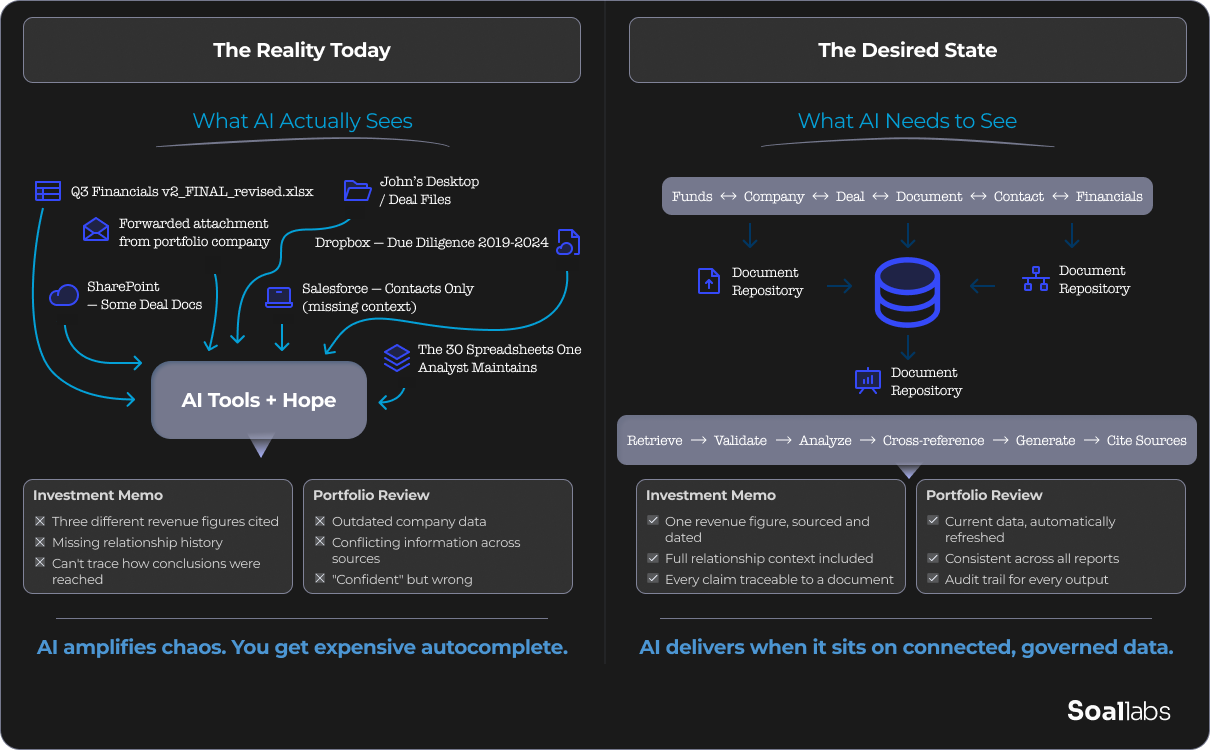
There's a reason the vendor demo was impressive, or the pilot worked on a narrow dataset, or the proof-of-concept showed promise. The inputs were controlled. Demos use clean, structured data, where the documents are properly formatted and labeled. The system knows where to look and what to look for.
Your reality is different:
- Portfolio company financials arrive in 14 different Excel formats, attached to emails, with no consistent naming convention
- Deal documents live across Dropbox, SharePoint, a legacy file server, and someone's desktop
- Your CRM has 60% of the contacts but none of the relationship context that lives in people's heads
- The "data warehouse" is actually 30 spreadsheets that one analyst maintains manually
When you point AI at this environment, whether it's an off-the-shelf tool or a custom build, it doesn't magically organize it. It just reflects the chaos back at you, confidently. This is why the same technology that looked transformational in controlled conditions produces mediocre results in production. AI amplifies whatever it sits on top of. If that's structured, governed data, you get leverage. If it's fragmented systems and tribal knowledge, you get expensive autocomplete.
The Real Gap Isn't Technology. It's the Data Foundation.
When we diagnose why AI initiatives are underperforming at PE and credit firms, we almost always find the same patterns:
The data isn't connected. Information lives in silos: CRM, portfolio monitoring, fund accounting, document repositories, email. The AI tool can only see what it's pointed at, and nobody has unified the picture.
There's no single source of truth. Ask three people for a portfolio company's revenue and you'll get three answers from three spreadsheets. The AI inherits this ambiguity.
Workflows aren't standardized. Every deal team runs diligence slightly differently. Every associate structures their memos their own way. The AI can't learn patterns that don't exist.
Nobody owns it. The tool was purchased, logins were distributed, maybe there was a training session, but there's no one accountable for driving adoption, defining use cases, or measuring results.
These aren't technology problems. They're data and operating model problems, and no tool, no matter how sophisticated, will solve them on its own.
What Actually Needs to Happen
The firms that extract real value from AI tools didn't start with the tools. They started with foundations:
Connected data. Systems that talk to each other. A deal record in the CRM that links to documents in the repository, financials in the monitoring system, and notes from the deal team.
Governed workflows. Standardized processes that create consistent, structured data as a byproduct, making it clear where AI can be leveraged and evaluated.
Clear ownership. Someone accountable for defining use cases, enabling the team, and measuring what's working.
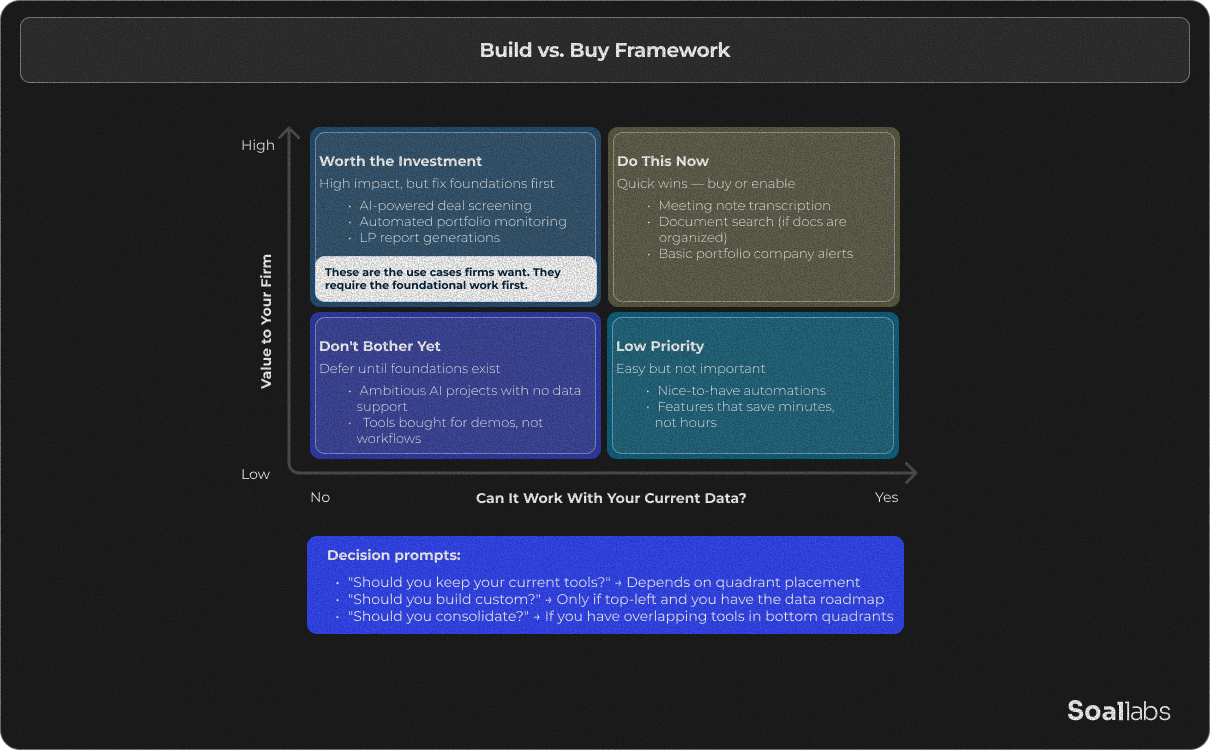
A realistic roadmap. Not a wish list of tools to buy, but a sequenced plan that acknowledges dependencies. You can't build AI-powered portfolio monitoring if you don't have clean portfolio data first.
This is the work that makes AI tools actually deliver. It's not glamorous. It doesn't demo well. But it's the difference between "helpful sometimes" and genuine operational leverage.
Introducing the AI Foundations Diagnostic
We built this for firms who have invested in AI—tools, pilots, people, custom builds—and aren't seeing the results. This isn't a readiness assessment for firms who haven't started. It's a diagnostic for firms who have, are stuck, and want to understand what's blocking progress.
What we do:
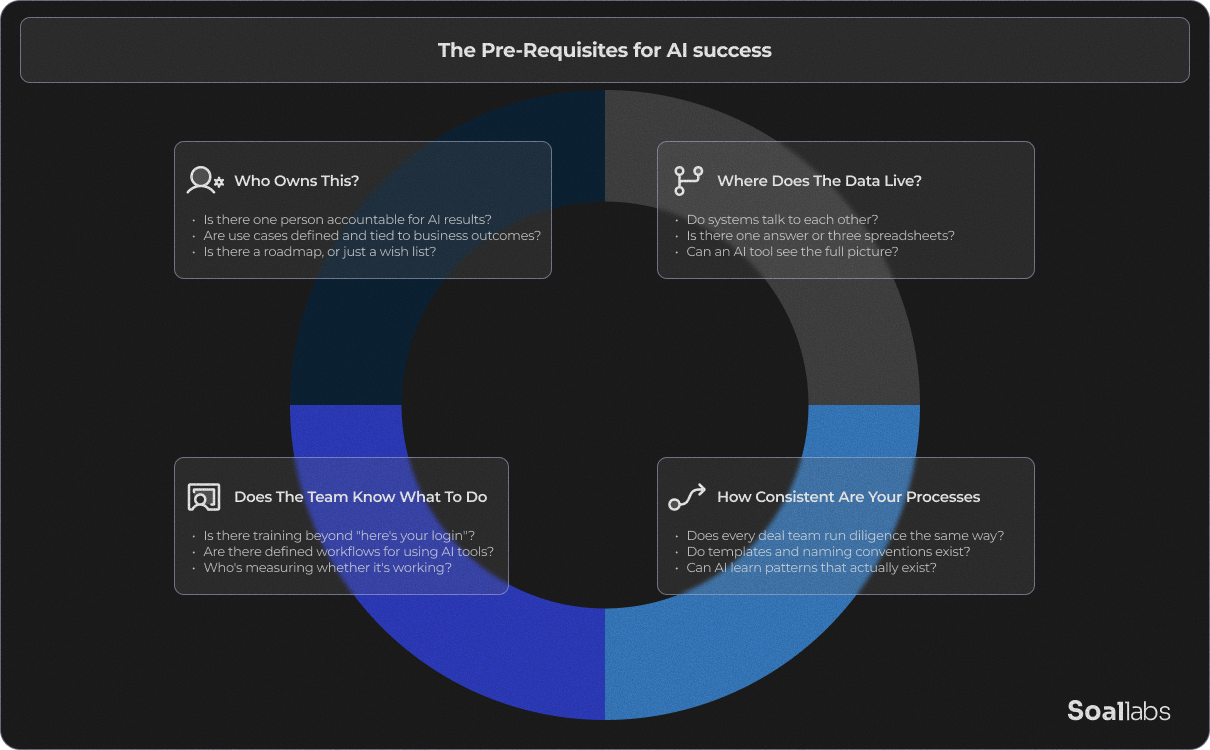
We evaluate your current state across four dimensions that determine whether AI tools can deliver value:
1. Strategy & Ownership Is there clear accountability for AI initiatives? Defined use cases tied to business outcomes? A roadmap that's realistic about sequencing and dependencies?
2. Data Foundations Where does your data live? How connected is it? Do you have systems of record, or systems of chaos? What would it take to give an AI tool the structured inputs it needs?
3. Workflow Maturity How standardized are your core processes: deal sourcing, diligence, portfolio monitoring, reporting? Where are the bottlenecks, and which ones would benefit most from AI augmentation?
4. People & Enablement Does the team know how to use the tools you've bought? Are there defined workflows, or just logins? Who's accountable for adoption?
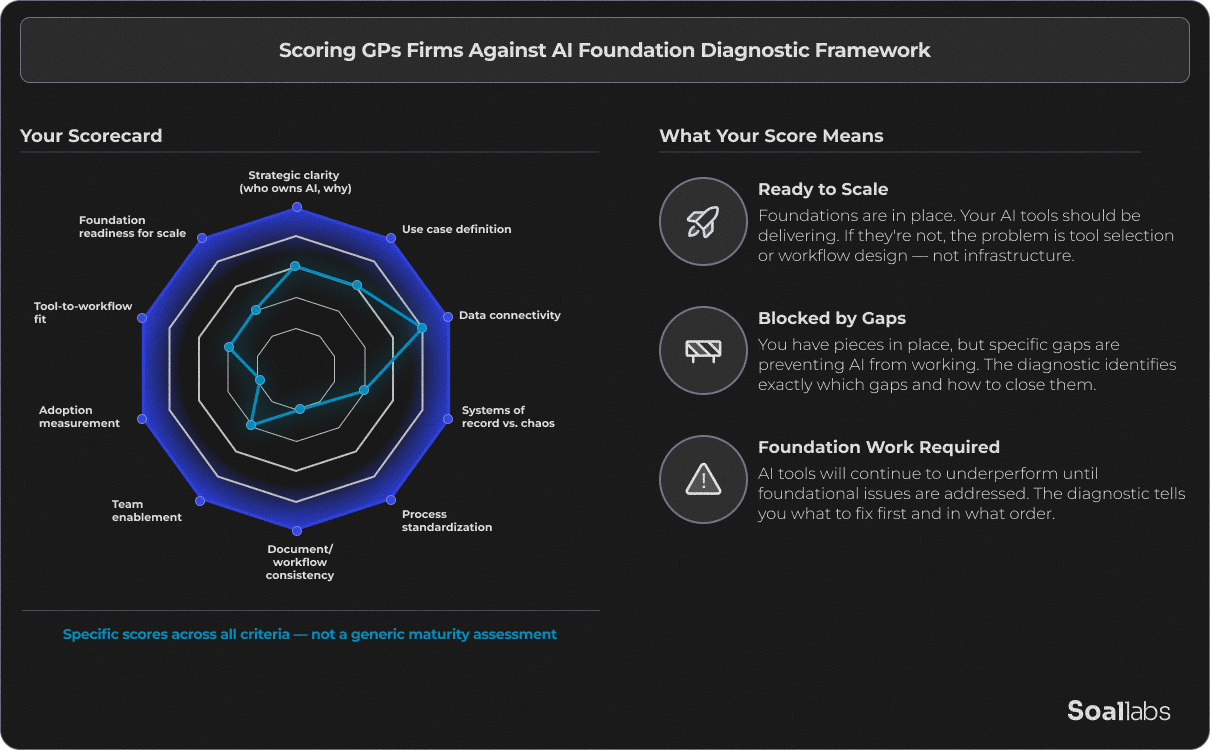
We score each dimension, identify the specific gaps blocking your AI initiatives from delivering, and build a roadmap to close them.
What You Get
1. Gap Analysis
A clear-eyed assessment of where you stand across all four dimensions with specific findings tied to your systems, your workflows, and your data.We'll tell you exactly why your current AI initiatives aren't delivering, and whether the problem is fixable or fundamental.
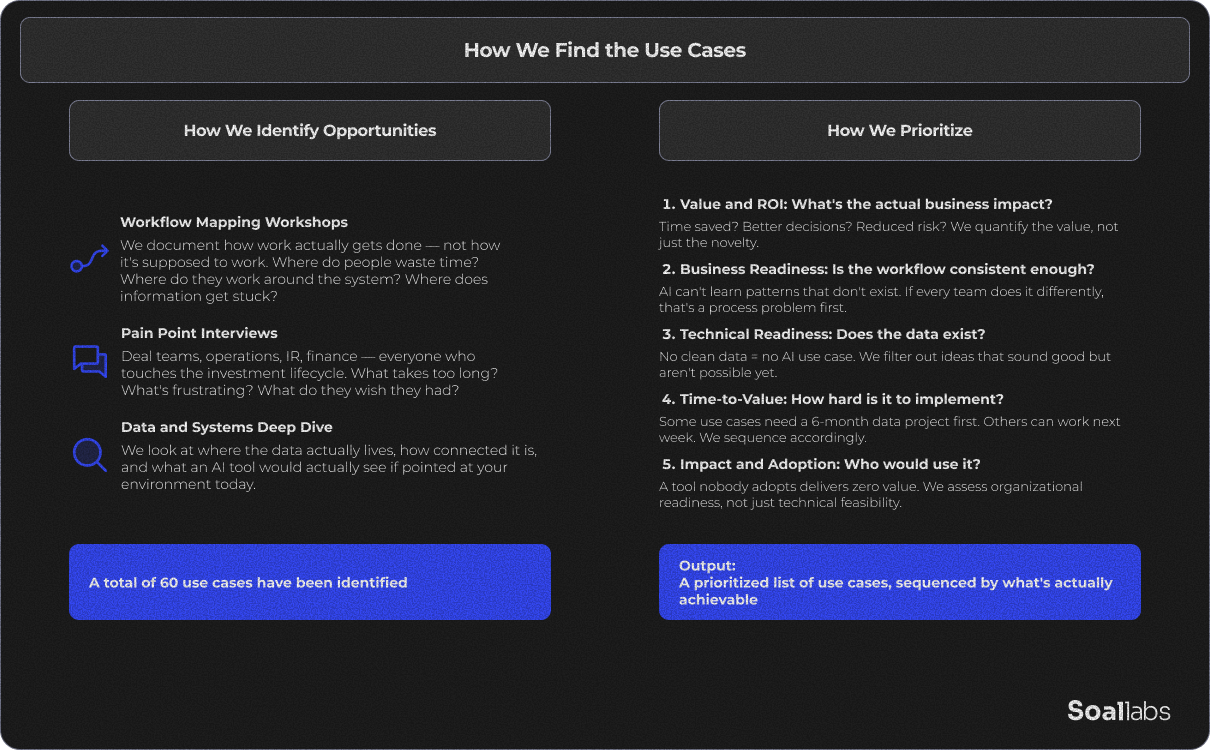
2. Prioritized Roadmap
A sequenced plan that acknowledges how this actually works. What has to be true before the next thing can happen. What's blocking the highest-value use cases. Where to start.The roadmap is specific enough that you could hand it to another vendor and execute it. We include:
- Phase 1: The foundational work that unblocks everything else, typically 1-3 months
- Phase 2: The use cases that become possible once foundations are in place
Each phase includes scope, timeline, dependencies, and investment range.The roadmap is specific enough that you could hand it to another vendor and execute it. We include:
3. Build vs. Buy Recommendations
Should you keep your current tools? Consolidate? Replace? Double down on a custom build or switch to off-the-shelf? We'll tell you whether what you've already built or bought can deliver value once foundations are in place, or whether you're better off cutting losses and redirecting.
What You Get
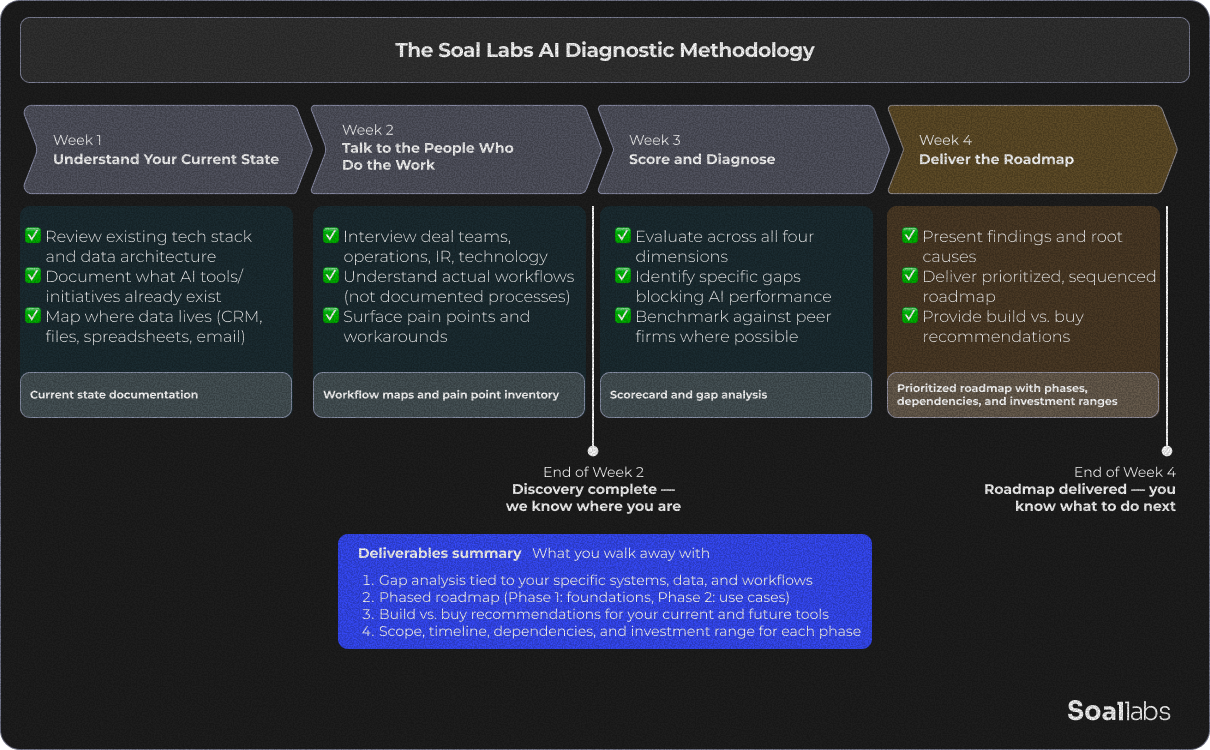
Week 1-2: Discovery
Through documentation review and stakeholder workflows, we review your current tech stack, data architecture, and any existing AI initiatives. We interview stakeholders across functions—deal teams, operations, IR, technology—to understand workflows and pain points.
Week 3: Analysis & Scoring
We evaluate your firm across our four-dimension framework, identifying specific gaps and their root causes. Where possible, we benchmark against peer firms.
Week 4: Roadmap & Delivery
We present findings and a prioritized roadmap. You leave with clarity on what's blocking your AI tools, what needs to happen to fix it, and a realistic plan to get there.
Who This Is For
This diagnostic is designed for PE and credit firms that meet specific criteria:
- You've already started on AI: with tools, pilots, custom builds, or internal initiatives, and you’ve found the results are underwhelming
- AUM between $5B and $50B: large enough to have operational complexity, not so large that you have unlimited internal resources
- Someone internally owns this problem: not as a side project, but as a real priority
- You want honest answers, even if they're uncomfortable
This isn't for firms looking for a vendor recommendation or a tool implementation. It's for firms that suspect the problem is deeper than the technology itself, and want to understand what it would actually take to get AI working.
What This Isn't
We believe in being direct about fit.
We're not going to tell you what you want to hear. If your data foundations are a mess, we'll say so. If your current tools are a poor fit, we'll say so. If the realistic timeline to get AI working is 12 months, not 3, we'll say so.
We may tell you we're not the right partner for the next phase. If the roadmap calls for work that someone else does better, we'll tell you that, too.
Why Soal Labs
We're a 25-person firm that only works with PE and credit. We're not learning your business on your dime.
We've seen the patterns: what works, what doesn't, and why. We've watched firms waste money on tools before creating the right foundation. We've also seen what happens when firms do the foundational work first: AI tools produce results.
Our belief is simple: AI without connected data is futile. This diagnostic is how we help firms see the gap between where they are and where they need to be.
If the diagnostic surfaces opportunities where we can help with execution, great. If it surfaces opportunities where someone else is a better fit, we'll tell you that too.No pitch. No pressure. Just clarity.
Next Steps
If you're a PE or credit firm that's started on AI and isn't seeing results, let's talk.
We'll hear what you're experiencing, share what we've seen at similar firms, and tell you honestly whether this diagnostic would be useful for your situation.
Soal Labs builds data platforms and AI systems for private capital firms. We help firms move from fragmented systems to connected infrastructure—the foundation that makes AI actually work.